Alone Together: The Studio Structure That's Actually Producing Better Work
If you've spent any time inside a creative studio — even a small one — you already know the feeling. You've got a strong idea, something that's actually interesting, and then the meeting happens. By the time everyone's weighed in, the sharpest edges have been rounded off. The thing that made the concept sing is now "a little too out there." You ship something competent. You move on.
It's one of the quieter frustrations in collaborative creative work, and it's more common than studios like to admit. But a handful of production companies and digital art studios across the US are starting to solve it in a way that sounds almost contradictory: by building teams specifically designed to protect people from each other.
The Myth of the Collaborative Breakthrough
We've been sold a version of creative collaboration that looks like a whiteboard session where everyone's energy feeds off everyone else's and something magical emerges from the group mind. That story makes for a great agency pitch. It doesn't always make for great work.
The reality is that most genuinely original creative breakthroughs happen in someone's head, alone, usually at an inconvenient hour. The team's job — when it's functioning well — isn't to generate the idea. It's to execute it, pressure-test it, and carry it across the finish line without losing what made it worth making in the first place.
That's a very different division of labor than what most studios are set up for. And recognizing the difference is the first step toward building something that actually works.
What Restructuring Actually Looks Like
Several studios that have made this shift describe it in similar terms: they stopped treating collaboration as a constant state and started treating it as a specific tool — deployed at the right moments, not running all the time.
In practice, this means that individual contributors own a creative direction completely before it's ever brought to the group. There's no early-stage committee. No "let's get eyes on this" when the idea is still fragile. The originating artist or designer has protected time — sometimes days, sometimes weeks — to develop a concept to a point where it can actually defend itself.
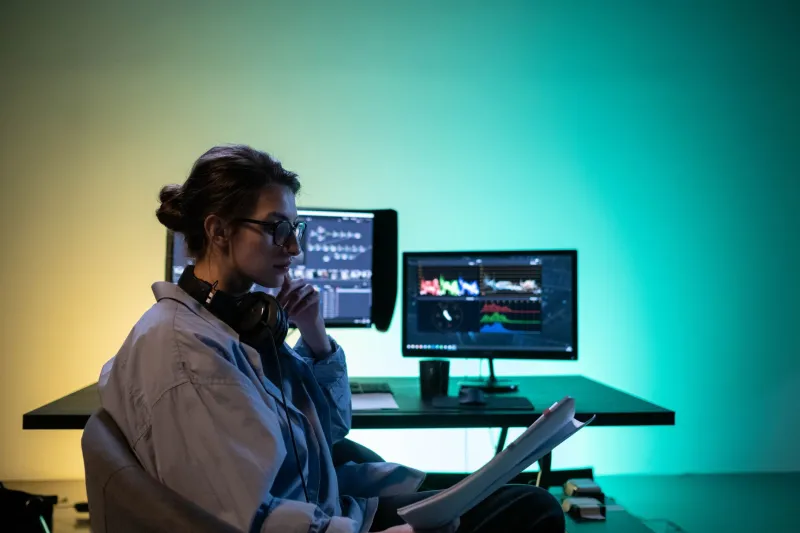
One motion design studio based in the Pacific Northwest restructured entirely around this principle after losing two senior artists in the same year to burnout and creative frustration. Their new model splits the week: three days of what they call "deep solo" work, where team members are essentially unreachable for non-urgent communication, and two days of collaborative review, handoffs, and planning. Output quality went up. Turnover dropped. The work started showing up in places it hadn't before.
That's not a coincidence — it's a system.
Asynchronous Collaboration as a Creative Tool
Remote work accelerated something that a lot of studios are only now fully processing: when you remove the default of real-time interaction, you force more intentional communication. And more intentional communication, it turns out, often produces better creative decisions.
When feedback has to be written down rather than blurted out in a meeting, people think harder before they give it. When you can't just pop over to someone's desk to "check in," you develop a more disciplined sense of when input is actually needed versus when you're just anxious.
Several studios have leaned hard into async tools — not just for logistics, but as part of their creative process itself. Video walkthroughs of work-in-progress, written creative briefs that get refined over multiple asynchronous rounds, voice memos capturing the thinking behind a direction. These aren't just communication workarounds. They're documentation of creative thinking that would otherwise evaporate in a room.
One Brooklyn-based digital art collective uses a system where every major creative decision gets recorded in a shared document before it's discussed verbally — a practice they borrowed from software development. The result is that conversations happen with more context, less ego, and a clearer record of why choices were made. When a project hits a rough patch, they can trace the logic rather than relitigating decisions from memory.
The Specialization Factor
Another piece of this puzzle is how studios are thinking about roles. The generalist creative — the person who can concept, design, animate, and present — is a real asset. But in a studio context, asking everyone to do everything is often what creates the conditions for mediocrity.
Studios that are producing consistently strong work tend to have a sharper sense of who does what and why. There's a conceptual lead whose job is to protect the vision. There's an execution team whose job is to realize it at the highest possible level. There are people whose specific skill is knowing when something isn't working — and saying so clearly, without politics.
That kind of specialization requires trust and clear communication about creative authority. But when it works, it means the person with the strongest vision for a piece isn't constantly pulled out of their creative flow to manage logistics or justify decisions to people who don't have full context.
The Tension That Makes It Work
Here's the thing that gets glossed over in conversations about protecting solo creative time: the team still matters enormously. The goal isn't to produce work in a vacuum — it's to bring genuine individual perspective into a collaborative structure without having it crushed in the process.
The studios doing this well are incredibly intentional about the moments when they do come together. Reviews are focused and specific. Feedback is structured around the creative intent, not personal taste. Decision-making authority is clear. And there's a shared understanding that the goal isn't consensus — it's the best possible version of the work.
That last part is harder than it sounds. It requires a certain kind of team culture where people are genuinely invested in the work being good rather than in being right. But when you build that culture deliberately, the results tend to speak for themselves.
Why This Model Is Spreading
The studios moving in this direction aren't doing it because it's trendy. They're doing it because the old model keeps producing the same outcome: talented people making safe work inside structures that reward agreement over excellence.
The digital art and design space is competitive enough that "pretty good" is table stakes. What separates the studios people actually talk about — the ones whose work makes you stop scrolling — is almost always a strong, specific point of view that came from somewhere real. That kind of vision doesn't survive a committee. It needs room to breathe.
Giving it that room, while still building a team capable of executing at scale — that's the actual challenge. And the studios figuring it out are doing something genuinely worth watching.