The Shelf Where Dead Ideas Go to Wait: Why We Never Delete a Failed Concept
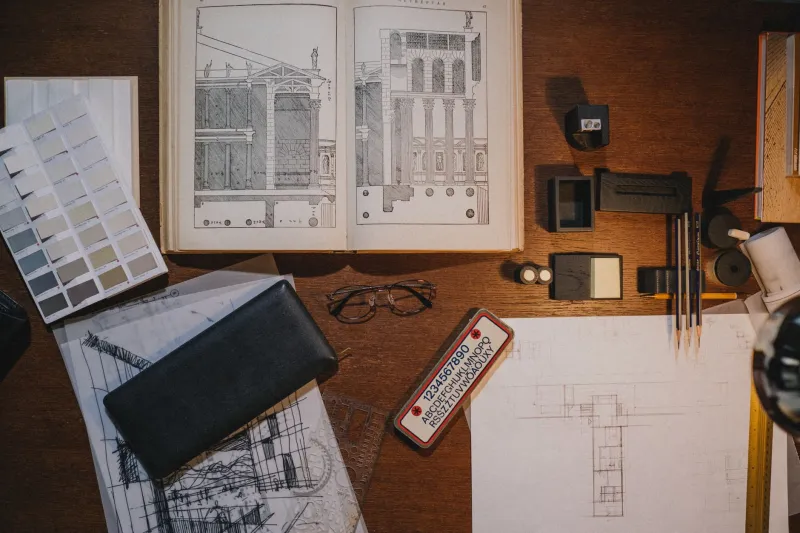
There's a directory on our server called _dead. Lowercase, no ceremony, no clever name. It's been there since the studio was two people, one rented lens, and a lot of optimism. Right now it holds somewhere north of 1,400 files: rejected logo marks, motion tests that died around frame 30, palettes we talked ourselves out of at 11 p.m., and three complete brand systems for clients who simply stopped answering email.
We have never deleted it. Not out of sentiment, and definitely not because we believe every failure is secretly a masterpiece waiting for its moment. We keep it because the folder has quietly paid for itself a dozen times over — and because the alternative, a spotless drive and a short memory, is how studios end up re-solving problems they already solved badly five years ago.
The case against the empty trash
Most teams treat a rejected concept like a typo. Fix it, ship the good version, pretend the bad one never happened. That works fine for typos. It's a lousy way to run a creative archive.
Here's the thing nobody says out loud: a rejected idea is usually not a bad idea. It's an idea that lost an argument. It lost to a budget, a stakeholder's gut feeling, a deadline, or a client who needed something safer for a board presentation in Boca Raton. None of that tells you the idea itself was wrong. It tells you the moment was wrong.
Delete the file and you delete the reasoning. Keep it and you keep a record of what you tried, what got vetoed, and — most usefully — what you were afraid of.
What's actually in there
Roughly four kinds of things, and they behave very differently.
Killed directions. Full concepts that made it to a client round and got cut. These are the most valuable files in the archive. They're polished enough to evaluate and unloved enough to be repurposed without anyone feeling weird about it.
Fragments. A single transition, a texture study, a lighting setup that took an afternoon and went nowhere. Individually useless. Collectively, a parts bin.
Version zero. The first pass on a project that got rewritten from scratch. Version zero is where the honest ideas live, before everyone got polite.
Orphans. Work for clients who disappeared. Twelve percent of our archive is this, and yes, we have a whole separate policy about what we can and can't reuse. More on that in a second.
The rule that stops the graveyard from becoming a landfill
The obvious failure mode here is hoarding. I've seen studio drives with 40,000 files and zero retrievability, which is functionally identical to having deleted everything.
So we run two rules.
One: nothing enters _dead without a note. A single line in the file's metadata — what it was for, why it got cut, who made the call. Takes twenty seconds. Without it, the file is noise in six months.
Two: every file gets a review date. Once a quarter, we sit down with coffee and a projector and walk the archive. Anything that hasn't been referenced, adapted, or argued about in three years goes to cold storage. Cold storage is not deletion, but it is a demotion, and it keeps the working archive small enough to actually browse.
The quarterly dig
The review takes about ninety minutes and follows a loose script. We don't ask "is this good?" — that's the wrong question and it always produces the same shrug. We ask three better ones.
- Did the constraint that killed this still exist? Budgets change. Clients change. A direction that was too expensive in 2023 might be perfectly reasonable in 2026.
- Does it solve a problem we're about to have? We usually know two or three projects out. If a shelved motion test matches the shape of an upcoming brief, it comes back out.
- Would we defend it now? Sometimes the committee was right. Saying so out loud, once a year, is good for the ego and the archive.
That's it. No scoring rubric, no database, no productivity influencer nonsense. Three questions and a decision to promote, hold, or demote.
How a dead end actually comes back
A few real ones.
A looping background animation we built for a coffee roaster's website in 2022 — cut because it was "too busy" for a homepage hero — became the opening title sequence for a documentary client two years later. Same file. Different frame. Nobody would have found it if it had been deleted for tidiness.
A rejected type pairing from a 2019 rebrand resurfaced as the basis for an entire editorial system. The client who killed it had wanted something more conservative. The client who adopted it wanted anything but.
And a lighting study that took four hours and got used for exactly nothing turned out to be the technical foundation for an installation piece we're currently prototyping. That one stings a little, honestly. Four hours in 2021, and we spent a week re-deriving it in the spring because we'd forgotten it existed.
The part that feels productive and isn't
Deleting is satisfying. It's the closest a creative studio gets to cleaning a garage, and it produces that same little hit of order.
But a studio's real asset isn't the work it shipped. It's the judgment it built along the way — and judgment lives in the failures, not the hits. The hits are the output. The dead folder is the reasoning.
So we keep it, we annotate it, we prune it, and once a quarter we open the lid and see what's still breathing. Most of it isn't. That's fine. It only has to be right about one file a year.


