The Vanishing Act: What Happens to Your Digital Art When the Internet Forgets It Existed
Somewhere in a server graveyard, there's a folder with Marcus Webb's early career in it. He spent three years building an illustration portfolio on a platform that felt, at the time, like the center of the digital art universe. Thousands of followers. Regular features. The kind of visibility that shapes a career trajectory. Then the platform pivoted, gutted its community features, and eventually shut down entirely. The export tool they promised arrived two weeks before the lights went out, and by then, most of Webb's original files were long gone—saved only at the platform's compressed resolution, stripped of metadata, and cut loose from the context that made them mean something.
"I had a body of work that represented basically my entire formative period as an artist," he said. "And it just... stopped existing. Not dramatically. Nobody eulogized it. The links just stopped working one day."
This is portfolio bankruptcy. It doesn't announce itself. It doesn't come with a warning letter. It happens incrementally—a dead link here, a deleted account there, a file format that nothing opens anymore—until one day you go looking for a piece of your own history and find a 404 error where your work used to be.
The Invisible Erosion
The digital art world has a permanence problem, and it's getting harder to ignore. Unlike oil paintings or bronze sculptures, digital creative work exists in a state of constant dependency—on platforms, on file formats, on servers, on companies that may not exist in five years. Every one of those dependencies is a potential point of failure.
Flash was once a dominant format for interactive and motion-based digital art. It's now functionally dead, and with it went an enormous body of work that simply cannot be viewed in its original form. Behance has restructured its community features multiple times, leaving portfolios half-functional and comment histories orphaned. Tumblr's content purge in 2018 erased huge swaths of digital illustration communities overnight. MySpace's server migration in 2019 wiped out roughly 50 million songs—a reminder that even large, established platforms treat historical data as a liability, not an asset.
And social media, which so many artists now treat as a de facto portfolio, is perhaps the most fragile container of all. Instagram has no export tool worth speaking of. TikTok's terms of service give it sweeping rights over uploaded content. Twitter, now X, has become structurally unpredictable in ways that would have seemed unthinkable three years ago.
"I tell younger artists all the time: you do not own your Instagram portfolio," said Diana Reyes, a digital illustrator based in Chicago who's been working professionally for over fifteen years. "You are renting space on someone else's platform, and they can redecorate or demolish the building whenever they want."
What Gets Lost Isn't Just the Files
When digital work disappears, it's not only the images or animations that go. It's the context—the timestamps, the process documentation, the comments and conversations that placed the work in a specific creative moment. It's the proof of authorship that matters when someone claims your work as their own. It's the developmental arc that shows clients and collaborators where you've been and how you got to where you are.
For established artists, that lost context can mean losing the evidence of a career. For emerging artists, it can mean losing the foundation that newer work was built on—the visual record of how a style developed, which matters enormously when explaining your creative voice to potential clients or collaborators.
Webb put it plainly: "Losing the work is bad. Losing the story of how I made it is worse."
Building Redundancy Into the Archive
The artists who've navigated this terrain without catastrophic loss tend to operate on one core principle: no single point of failure. Here's what that looks like in practice.
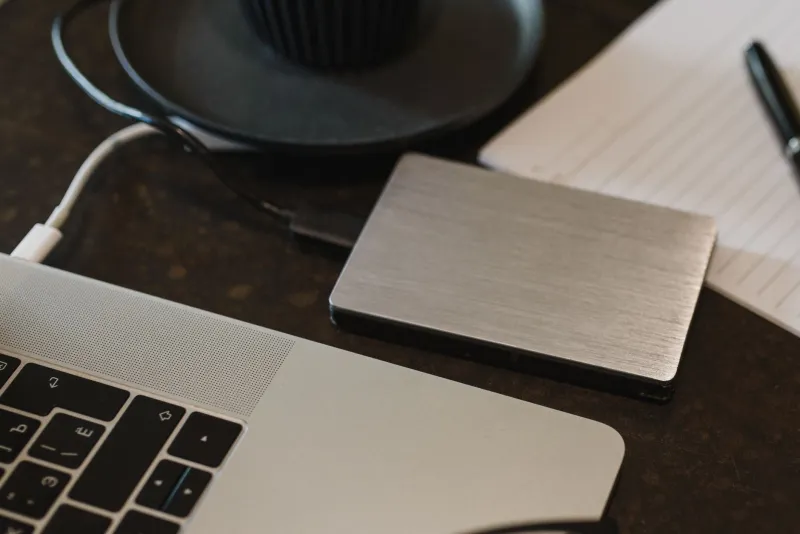
The three-location rule. Original files live in at least three separate locations—a local drive, a cloud backup (Backblaze and Dropbox are both commonly cited), and a physical external drive stored somewhere other than your primary workspace. This isn't paranoia; it's basic disaster architecture that most artists don't implement until after they've lost something important.
Format-agnostic exports. Proprietary file formats are a long-term risk. Saving working files in native formats (PSD, AI, CLIP) is necessary for editability, but archiving finished work as high-resolution TIFFs or lossless PNGs creates a format-neutral safety layer that's readable without any specific software ecosystem.
Metadata as documentation. Embedding creation dates, copyright information, and project context directly into file metadata costs nothing and travels with the file no matter where it ends up. Tools like Adobe Bridge or ExifTool make this straightforward.
The personal website as anchor. Platform-independent portfolio hosting—whether through a self-managed WordPress installation, Squarespace, or a static site hosted through GitHub Pages—creates a stable URL structure you control. Several artists we spoke with treat their personal domain as the canonical location for all their work, with social platforms functioning as distribution channels rather than storage.
Wayback Machine submissions. The Internet Archive's Save Page Now tool lets anyone submit URLs for archiving. It's not foolproof, but it's a low-effort way to create a third-party record of work that exists on platforms you don't control.
The Documentation Habit
Reyes developed what she calls a "close of project" ritual that's become non-negotiable in her practice. When a project wraps, she spends thirty minutes documenting it: exporting the final files in multiple formats, writing a short paragraph describing the brief and her approach, capturing screenshots of the work in its original context, and tagging everything consistently so it's findable years later.
"It's not glamorous," she said. "But I've watched so many artists lose work because they moved on to the next thing without ever actually preserving the last thing. The documentation habit is just as much part of the craft as the work itself."
The Larger Question
There's something worth sitting with here beyond the practical logistics. Digital art is still a relatively young discipline, and the field hasn't yet developed the institutional infrastructure that protects other creative legacies—the museum acquisitions, the archive donations, the estate management frameworks that preserve a painter's or sculptor's body of work across generations.
What exists right now is largely individual responsibility. And individual responsibility, distributed across thousands of artists each managing their own patchwork of drives and platforms and links, is a fragile system.
The artists who seem most at peace with this reality are the ones who've accepted that preservation is part of the job—not an afterthought, not something that happens automatically, but a deliberate practice that requires the same attention and intention as the work itself.
Because the work you made matters. And it deserves better than a 404 page.