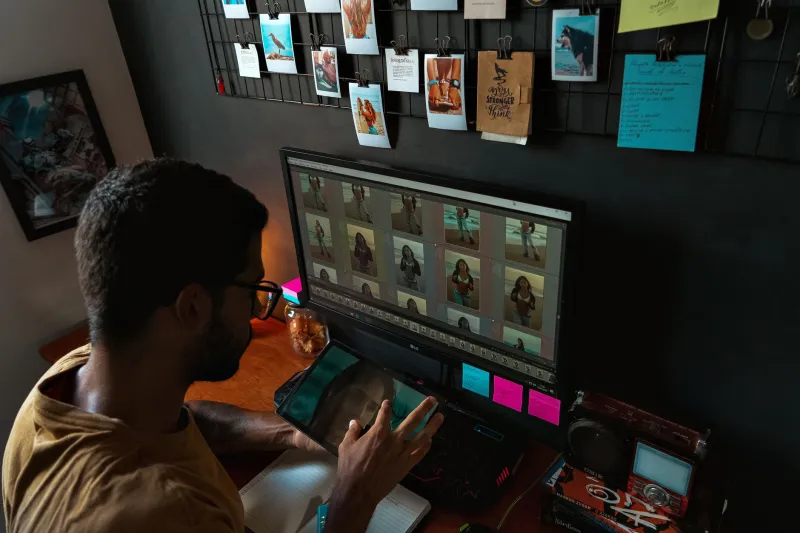
The Cost of Getting It Right: What Obsessive Craft Actually Does to Your Bottom Line

There's a version of this story every digital studio knows. The project was scoped. The timeline was set. Someone signed off on the budget. And then, somewhere around week three, the work started getting good — and everything went sideways.
Not sideways in a disaster sense. Sideways in the way that happens when a team genuinely cares. Another iteration. A tighter crop. A color grade that finally breathes. Before long, the original estimate is a distant memory, and the studio is eating hours it never planned to bill.
That gap — between what quality actually costs and what the invoice reflects — is what we're calling the Perfectionism Tax. And for a lot of studios, it's the single biggest threat to long-term sustainability that nobody talks about out loud.
What the Numbers Actually Look Like
Let's get concrete for a second. A mid-size digital studio in the US — say, five to twelve people, handling branding, motion design, or interactive work — typically builds project estimates using a combination of hourly rates and fixed deliverables. On paper, it looks clean. In practice, creative work rarely behaves like a spreadsheet.
Revision cycles alone can inflate a project's actual labor cost by anywhere from 20 to 60 percent, depending on the scope and the client relationship. That's not a made-up number — it's a pattern that shows up repeatedly when studios get honest about tracking time against estimates. And most don't track it closely enough to feel the full weight of it until cash flow gets tight.
The problem isn't revisions themselves. Iteration is part of the process. The problem is that most studios price for the expected version of a project, not the real one — the one where the client changes direction in round two, or where the creative director decides the first three concepts aren't strong enough to ship.
That second scenario is the one studios almost never charge for. Because the decision to push the work harder came from inside the house.
The Integrity Trap
Here's where it gets philosophically messy. The best digital studios — the ones producing work that actually moves people — are usually run by people who cannot let mediocre output leave the building. That's a feature, not a bug. It's the whole reason clients hire them.
But that same instinct, left unchecked, becomes an economic liability.
When a creative lead pulls a deliverable back for another pass because they know it could be better — not because the client asked — the studio is essentially subsidizing its own standards. That's admirable. It's also, over time, a slow bleed.
The studios that figure this out early are the ones that start treating internal quality passes as a line item rather than an assumption. They build what some call a "craft buffer" into their pricing — a protected block of time that exists specifically for the kind of refinement that never makes it onto a revision log but always makes it onto the final frame.
It sounds simple. It's surprisingly rare.
How Pricing Gets Emotional
Part of what makes this hard is that pricing creative work is never purely rational. There's ego in it. There's fear. There's the worry that if you charge what the work actually costs, the client will walk — or worse, they'll think you're not confident in your process.
A lot of studios underprice early work to build relationships, which makes sense as a strategy. The problem is that the relationship then gets built on a rate that was never sustainable, and raising it later feels like a betrayal of trust rather than a correction of economics.
This pattern shows up especially in digital art and design-forward studios, where the work is highly visible and the portfolio pressure is real. You want the project. You want the credit. You shave the estimate to make it happen. And then you spend six weeks doing $30,000 worth of work for $18,000 and telling yourself it'll pay off in exposure.
Sometimes it does. More often, it just sets a precedent.
Building a Rate That Reflects the Real Work
The studios that have cracked this — and there are some genuinely smart operators out there — have done it by changing what they measure. Instead of tracking hours against deliverables, they track hours against outcomes. What did it actually take to get this piece to the standard we ship at? Not the standard the brief asked for. The standard we hold ourselves to.
That distinction matters a lot. Because once you know your real cost-per-finished-output, you can start pricing from that number instead of from an optimistic projection.
Some studios build tiered offerings as a way to make this transparent with clients. There's a version of the project at the base rate, and there's a version with the full craft treatment. Not every client needs the latter. But offering it honestly — here's what it costs to do this the way we'd want to do it — is a more sustainable conversation than quietly absorbing the difference and hoping the referrals cover it.
The Burnout Connection
It's worth naming something that often gets left out of the business conversation: perfectionism isn't just an economic problem. It's a human one.
When studios consistently spend more creative energy than they're compensated for, the people doing the work feel it. Not just in their bank accounts — in their bodies, their sleep, their enthusiasm for the next project. The Perfectionism Tax doesn't just hit the P&L. It hits the team.
The studios that sustain great work over years — not just a hot streak — are the ones that figured out how to protect their people's energy by pricing honestly. They're not less obsessive about craft. They're just obsessive in a way that's structured to last.
What Getting It Right Actually Costs
At Studio 637, we think about this a lot. The whole premise of this place is that digital art and obsessive craft go together. But obsession without structure is just another word for burnout waiting to happen.
The studios worth watching are the ones learning to do both — to care deeply about the work and to build the financial scaffolding that lets that caring continue. That means tracking real hours. It means pricing with honesty rather than optimism. It means having the slightly uncomfortable conversation with clients about what quality actually requires.
Getting it right costs something. The studios that thrive are the ones who've figured out how to charge for it.