The Quiet Room Where the Real Work Happens
Ask any creative director about their best work and watch what happens. They'll probably talk about the team. The energy. The late nights in the war room surrounded by whiteboards and cold brew and people who got it. Collaboration gets credited for almost everything in this industry, and honestly, it deserves some of that credit.
But here's what they usually leave out: somewhere before all that team magic happened, somebody sat alone in a room and figured something out.
That part doesn't make it into the case study.
The Myth We Keep Selling Ourselves
The creative industry has a collaboration problem — not because collaboration is bad, but because we've started treating it like a starting point instead of a checkpoint. Studios schedule brainstorms before anyone's had time to actually think. Kickoffs happen before the problem is even properly understood. We fill rooms with smart people and expect the friction to produce fire.
Sometimes it does. More often, it produces a watered-down version of three different ideas that nobody fully believed in.
Psychologists have been writing about this for decades. The phenomenon has a name — brainstorming, in group settings, consistently underperforms what those same individuals would generate working independently before coming together. The social pressure to perform, to not look confused, to build on what someone else just said — it quietly shapes what ideas even get voiced in the first place.
For digital artists and studios doing complex, layered work — motion graphics, 3D environments, interactive experiences — this isn't just an abstract concern. It has real consequences for what ends up on screen.
What Deep Work Actually Looks Like in a Studio Context
There's a particular kind of creative state that serious digital artists describe in strikingly similar terms. Some call it flow. Some call it the trance. Some just say they were in it. Whatever the label, it's characterized by a near-total absorption in the work, where decisions come faster, connections happen more intuitively, and the internal critic goes quiet enough to actually try something risky.
You can't get there in 45 minutes between Slack notifications.
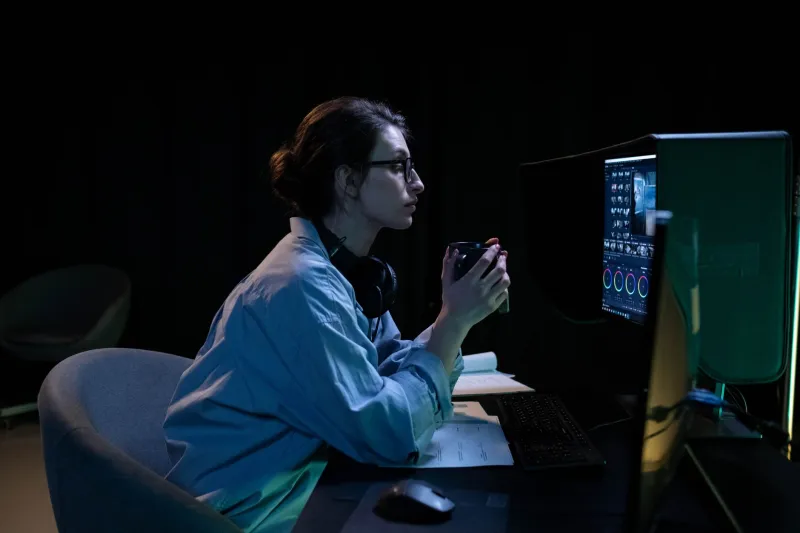
Motion designer Kira Nakamura, based out of Portland, describes blocking her first three hours of every workday as completely off-limits to communication. No client emails, no team check-ins, no open-door policy. "That's when I actually make things," she says. "Everything after that is reacting to things."
The distinction she's drawing — between making and reacting — is worth sitting with. A lot of what passes for creative work in studio environments is actually reactive work. Responding to feedback. Adjusting based on what the client said. Iterating on something that's already been shown to someone. That's all necessary, but it's not the same as originating.
The originating part tends to require a room with the door closed.
When Collaboration Actually Earns Its Keep
None of this is an argument against working with other people. That would be absurd. External eyes catch things you can't see anymore after staring at something for six hours. A collaborator with different technical skills can solve a problem you've been circling for days. And the emotional experience of making something with people — the shared investment in whether it lands — genuinely changes the quality of attention everyone brings.
The question isn't whether to collaborate. It's when.
The studios that seem to produce consistently strong work have figured out a rhythm that most don't talk about explicitly but all seem to practice intuitively. It goes something like this: one person (or a small core team) goes deep and solitary first. They develop a point of view. They make real decisions, even provisional ones. They get somewhere specific.
Then they bring other people in — not to generate the idea, but to pressure-test it, expand it, and catch its blind spots.
This sequencing changes everything about how collaboration functions. Instead of a group trying to conjure something from nothing, you have a group responding to something that already has a spine. The conversation gets sharper. The feedback gets more useful. People can actually push back against something concrete instead of grasping at vibes.
Designing a Workflow That Honors Both Modes
The practical challenge is that most studios aren't set up to protect solo deep work. Open office layouts, always-on communication tools, and meeting-heavy schedules all create environments that are optimized for constant availability — which is the enemy of the creative trance state.
A few structural changes that studios have actually used to address this:
Designated no-meeting windows. Not just for senior staff — for everyone. Even two or three hours a day of guaranteed uninterrupted time changes what's possible. Some studios go further and designate entire mornings as async-only.
The "rough cut first" rule. Before any work gets shared with the broader team or client, the originating artist has to have something real to show — not a concept board, not a mood reference, but actual work in progress. This forces the solo phase to happen before the collaborative one.
Separation between critique and creation. Feedback sessions are scheduled separately from working sessions, and people come to them having already reviewed the work independently. This prevents the group dynamic from flattening everyone's reaction into a consensus before anyone's had a real thought.
Permission to disappear. This one's cultural more than structural. Studios that produce strong individual creative voices tend to be places where going quiet for a few days to work something out isn't treated as antisocial behavior. It's treated as the job.
The Loneliness Is Part of It
Here's the thing nobody really warns you about when you start making things professionally: the moments right before something clicks are often deeply uncomfortable. You're sitting with a problem that doesn't have a solution yet. You're not sure the direction you've chosen is right. You can't ask anyone to confirm that you're on track because you're in territory where there's no track yet.
That feeling — that particular flavor of creative loneliness — isn't a sign that something's wrong. It's usually a sign you're close.
The studios and artists who've learned to tolerate that discomfort, to stay in the room with the unresolved problem instead of rushing toward the comfort of a team meeting, tend to come out the other side with work that surprises people. Including themselves.
Collaboration is real. The synergy is real. But somewhere upstream of all of it, someone sat alone and got honest about what they were actually trying to make.
That part of the process deserves a lot more credit than it gets.